
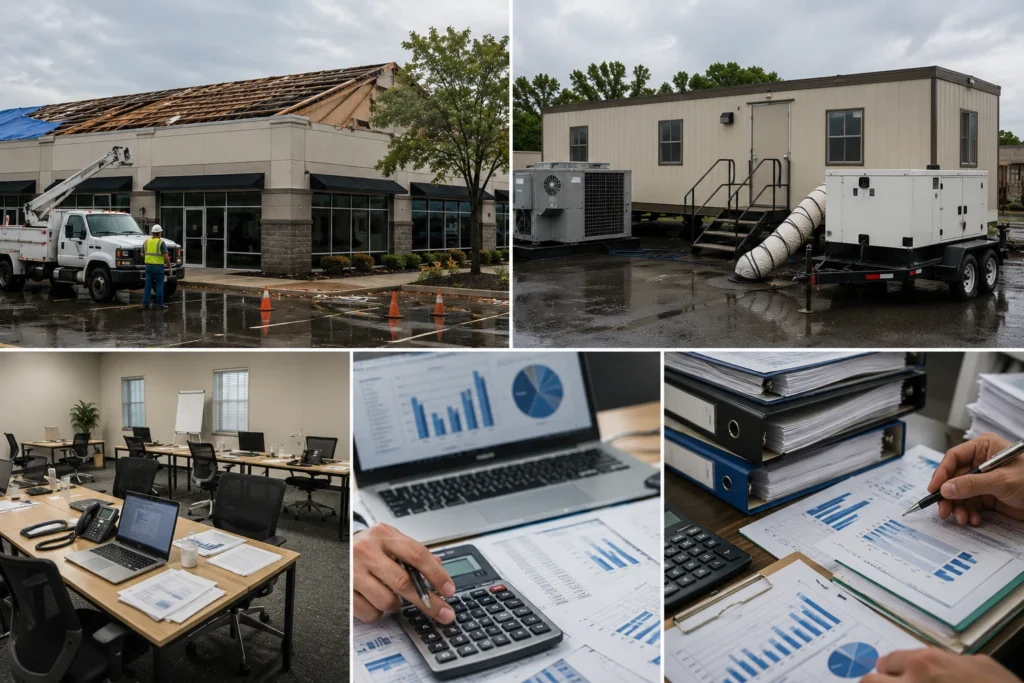
A commercial hail damage insurance claim can quickly become one of the most significant financial events a business owner faces. One severe storm can damage roofing systems, HVAC equipment, exterior walls, windows, signage, and other critical building components. While insurance exists to help businesses recover, the claims process is rarely as simple as many property owners expect. The challenge is not merely identifying visible damage. In many cases, the true scope of hail damage remains hidden beneath roofing materials, inside mechanical systems, or within building assemblies. As a result, business owners often discover that filing a commercial hail damage insurance claim requires far more documentation, investigation, and negotiation than anticipated.
Weather-related property losses can involve surprisingly complex factors. For example, understanding concepts such as Tribology the study of friction, wear, and material interaction—helps engineers evaluate how repeated impacts affect building materials over time. While most property owners will never need technical expertise at that level, it demonstrates how detailed commercial damage evaluations can become. For commercial property owners in Terrell, severe weather represents a recurring risk. Hailstorms can develop rapidly, causing substantial losses in a matter of minutes. Unfortunately, the financial impact often continues long after the storm passes. Understanding how commercial hail claims work can help business owners protect their properties, preserve their rights under the policy, and improve the likelihood of receiving a fair settlement.
Understanding Commercial Hail Damage
Commercial properties face unique vulnerabilities during hailstorms. Unlike many residential structures, commercial buildings often contain large roofing systems, specialized equipment, extensive exterior surfaces, and expensive operational infrastructure. Consequently, even moderate hail events can generate significant losses.
What Is Commercial Hail Damage?
Commercial hail damage refers to physical damage caused by hail impacting insured business property. Damage may occur directly from hailstones striking building components. Alternatively, hail can contribute to water intrusion, structural deterioration, equipment failure, and operational disruptions that continue developing after the storm.
Commonly affected properties include:
- Office buildings
- Retail centers
- Warehouses
- Industrial facilities
- Manufacturing plants
- Medical offices
- Apartment complexes
- Hospitality properties
The larger the structure, the more potential damage points exist.
Common Types of Commercial Property Damage Caused by Hail
Every storm produces different damage patterns. Some impacts are immediately obvious. Others remain hidden until a detailed inspection occurs.
Roofing Systems
Roofs absorb the majority of hail impacts.
Potential damage includes:
- Membrane punctures
- Granule loss
- Fractured shingles
- Cracked coatings
- Seam separation
- Water infiltration pathways
Even minor-looking impacts can shorten roof lifespan significantly.
HVAC Equipment
Commercial HVAC units often sit exposed on rooftops.
Hail may damage:
- Condenser coils
- Protective fins
- Electrical components
- Refrigerant systems
Reduced efficiency frequently follows.
Metal Components
Many commercial structures incorporate metal roofing, flashing, gutters, and wall panels.
Hail impacts may create:
- Dents
- Surface fractures
- Protective coating damage
- Corrosion vulnerabilities
Skylights and Glass
Skylights often sustain direct impact damage.
Potential issues include:
- Cracking
- Shattering
- Seal failure
- Water intrusion
The resulting leaks can affect interior operations quickly.
Exterior Signage
Signage represents a frequently overlooked loss category.
Damaged signs can affect:
- Brand visibility
- Customer perception
- Safety compliance
Unfortunately, these damages are sometimes omitted from initial insurance estimates.
Why Hail Damage Is Often Missed
One of the most frustrating aspects of a commercial hail damage insurance claim involves hidden damage. Not all hail damage creates obvious leaks immediately. Instead, deterioration may occur gradually. A roof membrane can sustain punctures that remain unnoticed for months. HVAC equipment may continue operating while internal damage reduces efficiency. Metal components may develop corrosion years after the original impact.
Consequently, a building can appear unaffected while significant damage exists beneath the surface. This delayed manifestation often creates disputes between policyholders and insurance carriers regarding causation, timing, and repair scope.
Does Commercial Property Insurance Cover Hail Damage?
Many commercial policies provide hail coverage. However, coverage depends on policy language, endorsements, exclusions, deductibles, and property-specific limitations. No two policies are exactly alike.
Typical Commercial Property Coverage
Most commercial property policies cover direct physical loss caused by hail.
Coverage frequently extends to:
- Building structures
- Roofing systems
- Attached fixtures
- Permanent equipment
- Business personal property
However, policyholders must demonstrate that covered damage actually occurred. Documentation becomes critical.
Understanding Wind and Hail Deductibles
Many business owners are surprised by hail deductibles. Unlike residential policies that often contain fixed deductibles, commercial policies may use percentage-based calculations.
Consider this example:
| Building Value | Deductible Percentage | Deductible Amount |
| $1,000,000 | 2% | $20,000 |
| $2,500,000 | 2% | $50,000 |
| $5,000,000 | 2% | $100,000 |
As property values increase, deductible exposure rises significantly. This often affects settlement expectations.
Common Coverage Limitations
Even when hail coverage exists, limitations may apply.
Examples include:
- Cosmetic damage exclusions
- Roof age restrictions
- Actual cash value endorsements
- Maintenance-related exclusions
- Surface wear exclusions
These provisions frequently become central issues during claim negotiations. Business owners should review policy language carefully before assuming damage is covered.
The Commercial Hail Damage Insurance Claim Process
Understanding the claims process helps business owners respond more effectively after a storm.
Step One: Conduct an Immediate Inspection
Time matters. As soon as conditions are safe, perform a preliminary inspection.
Focus on:
- Roof conditions
- Exterior walls
- Mechanical equipment
- Windows
- Skylights
- Signage
Do not place personnel in unsafe situations. Professional inspections often provide the safest and most accurate evaluation.
Step Two: Document Everything
Thorough documentation can dramatically strengthen a commercial hail damage insurance claim.
Capture:
- Wide-angle photographs
- Close-up damage photos
- Video footage
- Drone imagery
- Interior damage evidence
- Water intrusion indicators
Create organized records. The more evidence available, the stronger the claim presentation becomes.
Step Three: Preserve Weather Data
Weather information can become powerful supporting evidence. Important documentation includes:
- Hail size reports
- Storm path data
- Radar records
- Local weather service reports
This information helps establish that damaging conditions existed at the property location.
Step Four: Notify the Insurance Company
Prompt reporting protects claim rights. Delays can create complications. Insurance carriers may question:
- Cause of damage
- Date of loss
- Subsequent deterioration
- Maintenance history
Reporting quickly helps avoid unnecessary disputes.
Step Five: Prepare for the Insurance Inspection
Many business owners underestimate the importance of this stage. The carrier’s inspection often shapes the initial claim valuation.
Preparation should include:
- Organized documentation
- Inspection reports
- Maintenance records
- Photographic evidence
- Contractor evaluations
Being prepared helps ensure important damage is not overlooked.
Why Initial Insurance Estimates Are Often Incomplete
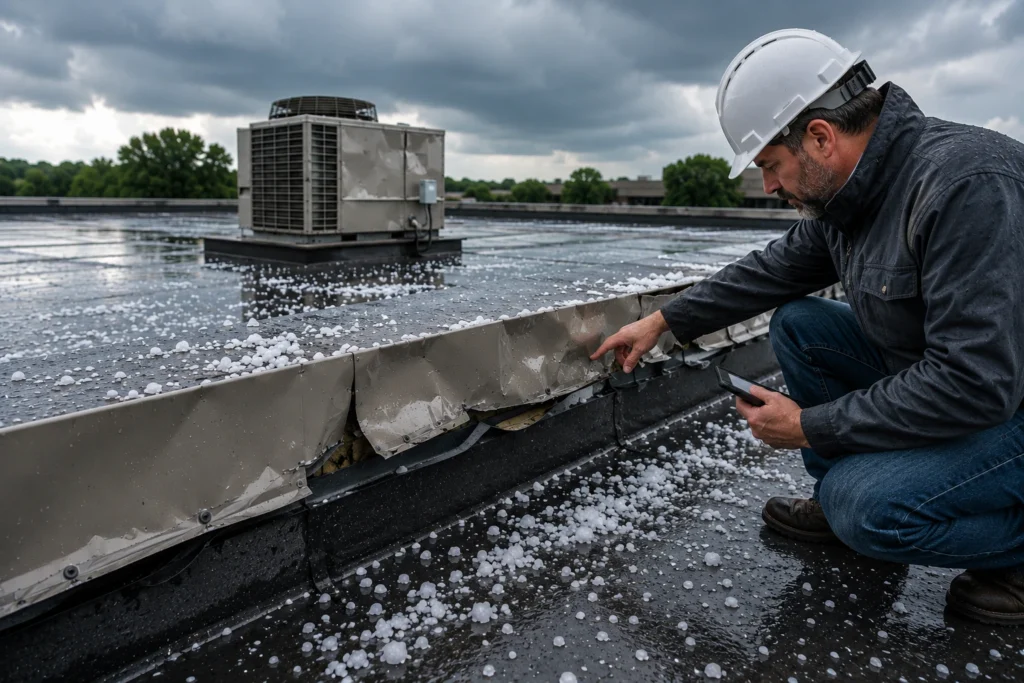
Insurance estimates represent a starting point. They are not always the final word. Commercial properties contain numerous systems and components that may require specialized evaluation. Adjusters often work under significant time constraints, particularly after widespread storm events. As a result, some losses may not appear in the initial estimate.
Common omissions include:
- Hidden roof damage
- HVAC impacts
- Flashing replacement
- Interior moisture damage
- Code-required upgrades
- Drainage system repairs
This explains why many commercial hail damage insurance claim settlements evolve through supplemental reviews and additional inspections.
Challenges Business Owners Frequently Encounter
Commercial claims can become surprisingly complicated. Several recurring issues appear repeatedly.
Underpaid Claims
Underpayments often result from incomplete inspections.
Examples include:
- Missing roof sections
- Unidentified collateral damage
- Inadequate repair scopes
- Improper material pricing
Even small omissions can create substantial financial shortfalls on large commercial projects.
Claim Delays
Delays may arise from:
- Documentation requests
- Inspection scheduling
- Coverage reviews
- Engineering evaluations
- Contractor availability
Meanwhile, property conditions may continue deteriorating.
Coverage Disputes
Insurance carriers sometimes argue:
- Damage is cosmetic
- Damage existed before the storm
- Damage resulted from wear and tear
- Maintenance deficiencies caused the problem
These disputes frequently require additional evidence to resolve.
How Hail Damage Affects Different Commercial Roofing Systems
Not all roofs respond to hail the same way. In fact, the type of roofing system installed on a commercial property often determines how damage appears, how severe it becomes, and how insurers evaluate the loss. Understanding these differences can help property owners recognize potential issues before they escalate.
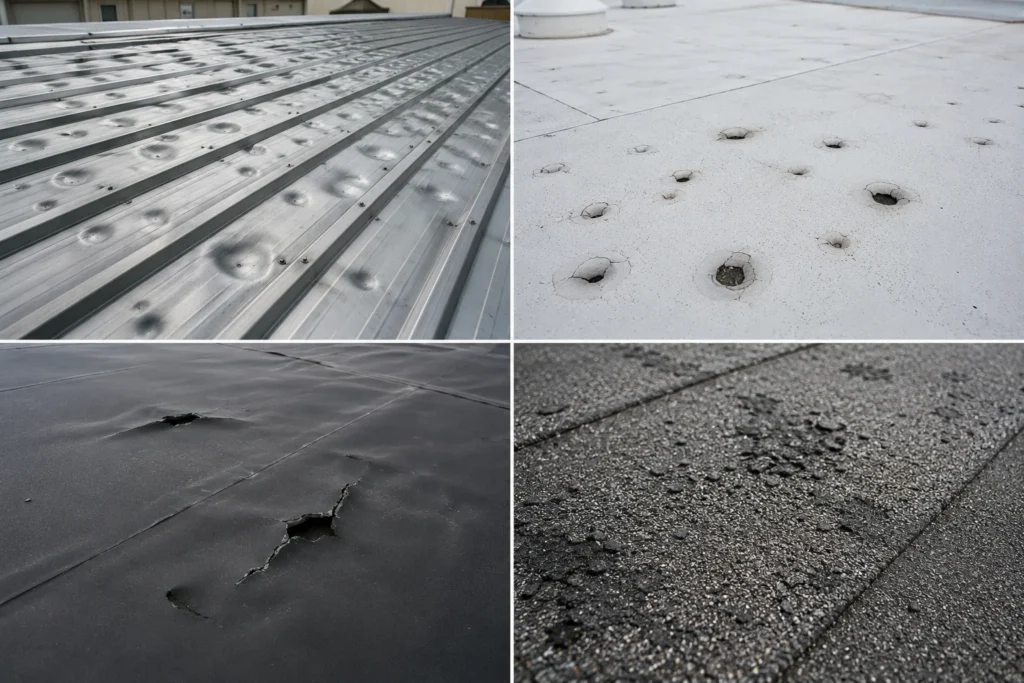
Metal Roofing
Metal roofs are common on warehouses, industrial facilities, and retail properties. At first glance, hail damage may appear cosmetic. However, appearances can be deceiving.
Potential concerns include:
- Dented panels
- Damaged protective coatings
- Compromised seams
- Accelerated corrosion
- Water intrusion pathways
Insurance carriers sometimes classify dents as cosmetic. However, dents can affect drainage patterns, panel performance, and long-term durability. A thorough inspection remains essential.
TPO Roofing
Thermoplastic Polyolefin (TPO) roofing has become one of the most widely used commercial roofing systems.
While durable, large hailstones can cause:
- Membrane punctures
- Surface cracking
- Seam damage
- Insulation compression
Even a small puncture can eventually allow moisture to penetrate underlying materials. The resulting repairs may be far more extensive than the visible damage suggests.
EPDM Roofing
EPDM roofs often absorb impacts differently than rigid systems.
Damage may include:
- Membrane tears
- Hidden fractures
- Seam separation
- Flashing failures
Because some impacts leave minimal visual evidence, specialized testing may be necessary to identify all affected areas.
Modified Bitumen Roofing
Modified bitumen systems contain multiple layers that can conceal hail impacts. Common issues include:
- Surface fractures
- Granule displacement
- Layer separation
- Accelerated aging
Damage may not become apparent until leaks begin appearing months later.
Built-Up Roofing Systems
Built-up roofs consist of multiple layers designed to provide durability. Unfortunately, hail can still cause:
- Surface displacement
- Embedded aggregate disruption
- Moisture intrusion
- Structural weakening
Professional evaluation helps determine whether repairs or replacement provide the most appropriate solution.
Asphalt Shingle Commercial Roofs
Although often associated with residential properties, some commercial buildings utilize asphalt shingle systems.
Potential hail-related damage includes:
- Granule loss
- Bruising
- Cracking
- Fracturing
- Reduced lifespan
The challenge is that many forms of shingle damage worsen gradually rather than immediately.
Business Interruption Losses After a Hailstorm

Property damage represents only part of the problem. Many business owners focus entirely on physical repairs while overlooking business interruption coverage. That can be a costly mistake. A severe storm may force temporary closures, limit operations, disrupt customer access, or reduce production capacity. The resulting financial losses can sometimes exceed the cost of physical repairs.
Understanding Business Income Coverage
Business income coverage is designed to help compensate for lost revenue resulting from a covered loss.
Depending on the policy, coverage may include:
- Lost net income
- Continuing operating expenses
- Payroll obligations
- Rent obligations
- Certain ongoing fixed costs
Coverage varies by policy, making careful review essential.
Extra Expense Coverage
Many businesses incur additional costs while attempting to continue operations. Examples include:
| Extra Expense | Purpose |
| Temporary office space | Maintain operations |
| Equipment rentals | Replace damaged systems |
| Temporary repairs | Prevent further damage |
| Relocation costs | Continue serving customers |
| Emergency mitigation | Protect property |
These expenses may be recoverable under applicable policy provisions.
Calculating Lost Revenue
Lost revenue calculations require documentation.
Helpful records include:
- Profit and loss statements
- Tax returns
- Sales reports
- Payroll records
- Historical operating data
The stronger the financial documentation, the easier it becomes to support business interruption claims.
Why Accurate Damage Documentation Matters
Documentation often determines the strength of a claim. Insurance companies rely heavily on evidence. Without sufficient documentation, legitimate losses may become difficult to prove.
Building a Strong Evidence Package
Strong claims typically include multiple forms of evidence.
Examples include:
- Photographs
- Videos
- Inspection reports
- Maintenance records
- Repair invoices
- Weather reports
- Engineering evaluations
Together, these documents help tell a complete story.
Using Weather Data to Strengthen a Claim
Weather information provides objective support.
Useful sources may include:
- Hail maps
- Radar imagery
- National Weather Service reports
- Storm tracking data
- Local weather observations
When combined with property inspections, weather data can strengthen causation arguments significantly.
Maintaining Detailed Records
Organization matters.
Property owners should retain:
- Inspection reports
- Maintenance logs
- Repair invoices
- Contractor proposals
- Correspondence with the insurer
Claims often last months.
Good recordkeeping prevents important information from being lost.
Commercial Hail Damage Claim Mistakes to Avoid
Some mistakes appear repeatedly. Unfortunately, they can significantly reduce claim outcomes.
Waiting Too Long to Report Damage
Time rarely helps a hail claim.
Delays may create questions regarding:
- Cause of damage
- Timing of loss
- Property maintenance
- Additional deterioration
Prompt reporting protects important rights.
Assuming the Insurance Estimate Is Complete
Many policyholders believe the initial estimate represents the final settlement value. Often, it does not. Commercial properties contain complex systems. Additional damage frequently emerges during repairs or more detailed inspections.
Making Permanent Repairs Too Quickly
Emergency mitigation is important. Permanent repairs, however, should generally be approached carefully. Premature repairs may eliminate valuable evidence before documentation is completed. Photograph everything first.
Failing to Preserve Evidence
Evidence matters.
Whenever possible, retain:
- Damaged materials
- Photographs
- Inspection reports
- Samples of impacted components
Preserved evidence can become extremely valuable during disputes.
Accepting the First Settlement Without Review
Initial settlement offers deserve careful examination.
Questions worth asking include:
- Were all damaged components included?
- Was pricing accurate?
- Were code requirements considered?
- Was hidden damage evaluated?
A detailed review often reveals areas requiring further discussion.
Do I Need a Public Adjuster?
This is one of the most common questions business owners ask after a major storm. The answer depends on several factors. Smaller, straightforward claims may proceed smoothly without additional assistance.
Large commercial losses, however, often involve:
- Complex damage evaluations
- Significant financial exposure
- Coverage interpretation issues
- Multiple inspections
- Settlement negotiations
In these situations, professional representation may provide substantial value. The key is understanding the size and complexity of the claim before deciding how to proceed.
How a Public Adjuster Helps With a Commercial Hail Damage Insurance Claim
A public adjuster works on behalf of the policyholder rather than the insurance company. Their role focuses on documenting, presenting, and negotiating the claim.
Independent Damage Assessment
Independent evaluations often identify damage that may not appear in initial inspections.
This includes:
- Roofing systems
- Mechanical equipment
- Interior damage
- Code-related issues
A comprehensive assessment creates a stronger foundation for negotiations.
Policy Review
Commercial insurance policies contain numerous provisions. Important areas include:
- Coverage grants
- Exclusions
- Endorsements
- Deductibles
- Additional coverages
Understanding these provisions can significantly impact recovery.
Scope Development
The scope of damage forms the backbone of the claim. An accurate scope helps ensure:
- All damage is identified
- Repair requirements are documented
- Costs are properly estimated
Incomplete scopes often lead to underpaid claims.
Settlement Negotiation
Negotiation is frequently necessary. Insurance companies and policyholders do not always agree on:
- Damage extent
- Repair methods
- Pricing
- Coverage interpretation
Professional negotiation can help bridge those gaps.
Why Commercial Property Owners in Terrell Should Take Hail Damage Seriously
Commercial properties in Terrell face ongoing exposure to severe weather conditions. Storm activity does not need to produce catastrophic destruction to create significant losses. Sometimes, a brief hailstorm can cause damage that remains hidden until months later. That is why proactive inspections matter. Business owners in Terrell should consider scheduling inspections after significant hail events even when obvious damage is not visible.
Early detection can prevent:
- Water intrusion
- Structural deterioration
- Mold development
- Equipment failures
- Expensive future repairs
The sooner damage is identified, the more options typically remain available. Additionally, property owners in Terrell often benefit from maintaining detailed maintenance records throughout the year. These records can help demonstrate pre-loss conditions if a future claim dispute arises.
Advocating for Full Restoration
Insurance exists for a reason. Businesses purchase coverage to protect investments, maintain operations, and recover from unexpected losses. A properly prepared commercial hail damage insurance claim supports those objectives. An incomplete claim often does not.
The goal should never be merely obtaining a payment. The goal should be restoring the property to an appropriate condition while protecting long-term business interests. That requires accurate inspections. It requires thorough documentation. It requires understanding the policy. And sometimes, it requires challenging assumptions about the true scope of damage.
Conclusion
A commercial hail damage insurance claim involves far more than reporting storm damage and waiting for a check to arrive. Commercial properties contain complex systems, expensive equipment, and operational risks that can dramatically affect claim outcomes. Hidden roof damage, HVAC impacts, business interruption losses, code requirements, and documentation challenges all influence the final settlement.
Business owners who respond quickly, document thoroughly, preserve evidence, and carefully review insurance estimates place themselves in a stronger position throughout the process. Most importantly, never assume that visible damage tells the entire story.
Whether managing an office building, retail center, warehouse, industrial facility, or multi-family property, a thorough evaluation after a hailstorm can help uncover losses before they become larger problems. When substantial damage occurs, taking a proactive approach to a commercial hail damage insurance claim may be one of the most important financial decisions a business owner makes. The effort invested today can make a significant difference in both recovery speed and settlement outcomes tomorrow.
FAQs
A commercial hail damage insurance claim is a request for compensation under a business property insurance policy for hail-related damage.
You should report the damage as soon as possible to avoid delays and potential disputes regarding the cause of the loss.
Many policies cover hail damage to HVAC equipment, but coverage depends on the policy terms and any applicable exclusions.
Yes. Hail can damage roofing materials, seams, and membranes without causing immediate leaks.
Photos, videos, inspection reports, maintenance records, weather reports, and repair estimates can all strengthen a claim.
You can seek additional inspections and expert evaluations to determine whether the damage affects the function or lifespan of the property.
Many commercial policies include business interruption coverage that may compensate for lost income during repairs.
Some policies use percentage-based deductibles that are calculated based on the insured value of the property.
In many situations, supplemental claims may be submitted if previously hidden damage is identified during repairs.
A public adjuster can document damages, review policy provisions, prepare claim support, and negotiate with the insurer on behalf of the policyholder.